


 By
By Remote Working
Remote working culture has become a new trend lately. Who doesn’t want to stay at home and work while watching Netflix at the same time? I’m sure many of you dream about that lifestyle. Well, researchers say that working from home is more productive in comparison to working from office.
Remote employees are more productive than office employees
Airtasker, an outsourcing company had surveyed 1,004 full time employees and concluded that on average, remote employees worked 1.4 more days every month, than those who worked in an office. This means remote working culture definitely adds productivity, efficiency and flexibility at work.
Commuting from home to work and work to back home is frustrating sometimes. The traffic jams, irritating honking noises and parking issues burst your head with rage when you are few minutes late for office. The research also shows that one to four employees quit their job because of time consumption while traveling to office.
The workload is same and if it can be done from home, then why not work from home? It saves your time and you can utilize those time in a much productive manner. Survey showed that ‘remote workers’ or personals working outside of their regular office environment are likely to save an equal or more than 408 hours of free time working from home. It is equivalent to 17 days of a year. You can complete half-dozen TV series, learn how to cook, complete a long vacation trip and still have time to sleep an hour more during those free fortnights.
Remote employees are more focused and they prioritize work
It is also noticed that employers are frequently disturbed or distracted by their department heads or boss when at work. Unimportant gossips, and unproductive gatherings kill your time. Research shows that nearly 65% couldn’t work because their boss are too talkative and another 52% said they were stressed out by their boss.
In contrast only 15% among remote workers said they were diverted by their senior managers and bosses. It seems that you are less prone to get disturbed if you are working on your own from your room.
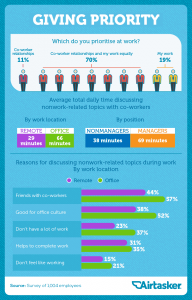
Photo by Airtasker
Also majority of the workers claimed that work and relationship with co-workers were equally important and only 19% (very few) prioritized work over relationships with co-workers. Staffs working at office speak on average 66 minutes with co-workers about non-work related topics whereas remote workers speak only 29 minutes about non-work related topics to co-workers. That saves 37 minutes of free productive time.
It is also filed that 21% employees don’t feel like working, which is 6% more in contrast to remote workers.
Remote employees save more time and money
Another two year study of a major Chinese travel company by Nicholas Bloom, an economics professor at Stanford University found out that working from home made the employees much productive and they are less likely to quit their job.
Workers from home led to 13% performance increase, of which 9% worked more minutes per shift which means fewer breaks and less leaves. The study also mentioned that the commuting expenses and pocket costs were reduced gradually, making employees work more honestly and productively.
There are few drawbacks:
Everything has its dark side, so does remote workers have. Though working from home can be exciting and relaxing, this lifestyle also has few drawbacks and negative impacts on personal behavior. Survey shows remote workers gets comparatively a bit more stressed at work, and procrastinate often until its deadline. But this doesn’t mean they don’t work at all. You can simply make a to-do-list and take breaks to stay productive and motivated at work.
Remote working culture is definitely increasing day by day but traditional office culture is also in the race. It is completely upon us to choose which lifestyle we prefer. Some may prefer remote working culture and some love traditional work style.
A quick tips: Before you shift for a permanent remote working culture, make sure you are prepared to tackle both its benefits and drawbacks.
Follow Offline Thinker on Facebook, Twitter, and Instagram. You can send us your writings at connect.offlinethinker@gmail.com