

 By
By Why does this most simple digital medium capture our attention in particularly unique ways? Funny, stupid and sometimes poignant, but how and why did this form of culture become so popular, and potentially, so powerful? Why did this culture divide people apart?
Originally, the term “meme” was used by an English ethnologist and evolutionary biologist Richard Dawkins in his book ‘The Selfish Gene’1976. “What lies at the heart of every living thing is not a fire, not warm breath, not a ‘spark of life.’ It is information, words, instructions,” Dawkins had declared. Meme is a neologism to describe ‘self – reproducing ideas’. It explains how ideas replicate, mutate and evolve. “We need a name for the new replicator, a noun that conveys the idea of a unit of cultural transmission, or a unit of imitation” – ‘The selfish Gene’. It is based on the idea of a gene but, instead of biological information, it transmits socio – cultural information through processes like socialization and involves numerous phenomena such as language, religion, music, race and gender, which consequently influence people’s attitudes, beliefs and values towards certain issues.
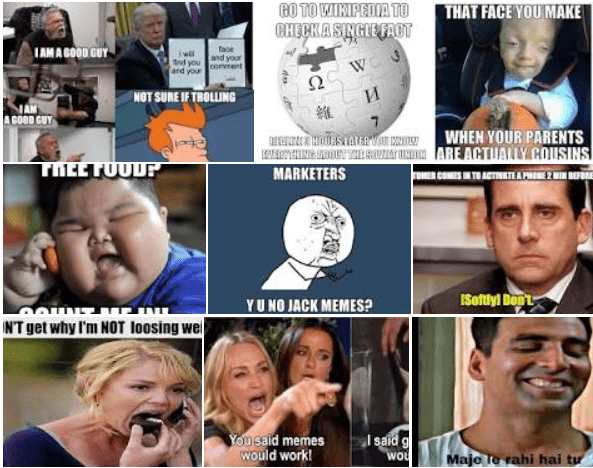
Since then, its meaning has rapidly changed with the rise of technology in the late 20th and early 21st centuries; known as` the realm of public consciousness. It now refers, in internet language, to picture, sounds, videos or websites that are shared or reproduced from person to person through social media and user – generated content websites like Facebook, Twitter, YouTube, Tumblr, Reedit, etc. These content are composed of an image, either an illustration or a photograph, accompanied by text and are usually humorous and sarcastic. Under this form only what is written changes. This way, a new story or a new joke is created.
Simple traditional meme, often featuring a single word or phrase have evolved to more complex and elaborated things such as image macro, GIFs(Graphics Interchange Format) and other viral sensations. Dawkins in his book has explained that internet memes are thus a “hijacking of the original idea”. Generating memes and actively promoting meme – sharing within such groups and digital fields and asking for feedback have supported to the rise of internet memes.
The first internet meme was the sideways “smiley” ‘🙂’ created in 1982 by American computer scientist Scott E. Fahlman. The practice of using punctuation markers to show emotion was quickly picked up by internet users all over the world, and several other expressions, such as 🙁 and 😉, were added to the repertoire of the “emoticon” meme. In 1998, the Hampster Dance meme – depicting rows of dancing hamster GIFs, on the website of Canadian art student Deidre Lacarte – became popular. By the end of June 1999, the site had been visited Seventeen Million times. This meme, as simple as it may be, is one of the first examples of viral digital content. From then to now, new breeds of memes covering various social content have emerged as digital communications have changed and evolved drastically. As more and more time is spent online, memes have become the perfect vehicle for facilitating information, humor, and opinion. Evolving from basic image edits made to make people laugh into rhetorical devices capable of disseminating information to millions of people, memes have established themselves as one of the most important mediums today.
There is no particular reason behind meme culture being most popularly accepted by all. As the internet evolved, so did memes. Emotional outbreaks, stress relief, and socialization among people, most often teenagers, around the world have helped meme culture grow globally. Social sites like Instagram, Facebook, Twitter, Tiktok, Snapchat, Youtube, have become a source of news and information by generating and sharing memes. Some people claim that memes are like an ‘anti-depression pills’; counter attacks depression. Over the time, meme culture has infiltrated various aspects of daily life. While some memes have also taken to making political comments on current issues, political operatives expect memes to be an effective campaigning tool. It sparks controversies and starts a conversation that might need to be had over a particular issue. Memes are used in marketing slogans for TV advertisements in the storylines of video games. Memes have infiltrated every source of form of news, information and entertainment and of course, there is a downside to everything.
Meme culture has created a huge gap between teens and other older generations. In the recent years memes have become a defining part of how people, especially teenagers, communicate in the digital world. Young people have begun using/sharing memes in order to support or dismiss a social cause, a public figure’s actions, political agendas, campaigns, protests and much more. Since the older generations are neither familiar with social media operations nor memes, they seems to be left out of the conversation. Meanwhile, the instant spread of memes through social media seem to have two effects on a current issue; either making a mountain of a mole-hill or deprecating it to a joke. For example, a photo of a woman wearing a strapless top sitting behind a government motorbike was excessively shared in the form of meme in different social media platforms. Although it was nothing of grave importance, it remained a topic of discussion for quite a few days by exaggerating it to the point of questioning the woman’s character, throwing verbal abuses at her and justifying violence against women by pointing to her choice of clothes. This shows a glimpse into how memes also have a hand in spreading racism, sexism, homophobia and hyper-sexualization. While it may not seem appropriate to have such offensive memes present in the digital world, it is the very fact that we let them remain there that legitimizes them. Allowing these offensive meme sources to exist reinforces the acceptance of racist, sexist, and abusive attitudes.
Under the umbrella term of ‘dark humor’ few groups, race, sex, class and gender have been dehumanized through such memes. Due to the heavy numbers in which memes are generated and spread daily, the offensive and offside of memes go largely unacknowledged. While meme generators defend these offences by claiming that there exists a layer of irony within these memes, they should understand that not everyone understands the supposed satire. Generating, accepting and spreading contents of dark humor makes light of serious issues that are offensive towards victims and survivors of abuse. Creating and circulating pictures of acid attack survivors with captions such as ‘ugly’, ‘ghosts’ and such is an insult to their excruciatingly painful experience for which they must be acclaimed rather made a joke of.
Everything that we see around have undergone evolution. Evolution is in fact the law of nature, which we cannot avoid but can act if it strays to an unrighteous. Memes with dehumanizing and offensive content must not go unnoticed. People should no longer sit and passively scroll through dark humors contents. Victims and survivors of abuse should no longer tolerate. Women and gender minorities should no longer succumb to the dominant patriarchal definitions of humor that seek to tear them down in every possible way. If we encourage the spread of such memes then the ironic guise will disappear and leave us with explicit abuse and discrimination.
There is no denying that memes have also boosted several positive campaigns and agendas to tackle various social issues but it is crucial that its dark side is highlighted too. We know that the Internet is the ideal avenue to voice our opinion and better way to educate the masses. Why not use this platform to make people aware of the spread of false information rather than reinforcing the spread of offensive memes. It is high social sites and meme sources acknowledge these wrongs and push towards creating and spreading more inclusive and authentic content. May every individual receive the respect they deserve.
-Abhyuday Bhetwal
