
 By
By Professor Murod Ikromovich looked fast at his watches, then corrected his glasses, bent from one side, and looked at the main hall of the theater, stretching his neck.
“The premiere is going to start right now.”
At that moment both of my eyes were on the name of the spectacle, written on the poster.
“Professor, does the name of the spectacle seem strange to you too?” I said after we came in and took our seats, reminding him about the poster, written with big letters.
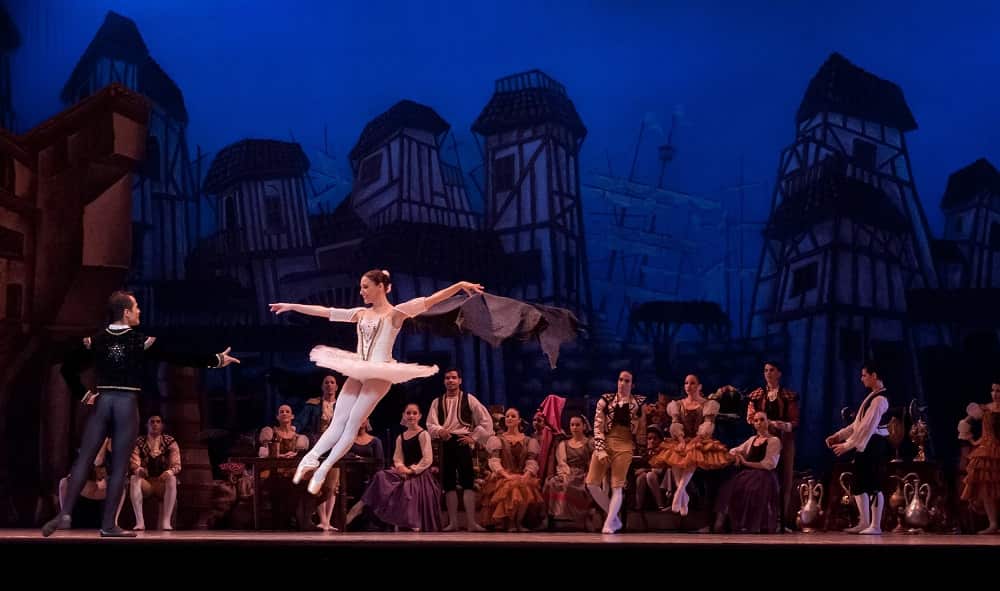
He, impatiently waiting for the curtains to rise, nodded as if to confirm and say “ Yes, it is”. After some minutes, the curtains rose and the spectacle started. The actors began performing the roles, given to them by the director. Their movements, their state in monologues and dialogues are still in front of my eyes. The few spectators, who gathered in the hall, were watching the spectacle with this interest.
“Till this time I have only read Guntekin’s* novels,” he said, coming close to my ear in the middle of the spectacle.” Here are his amazing plays, written to play on a stage. Yes, as you said, “Khalala” is a strange name for the play. But, do not pay attention to it.”
Although the drama, which became interesting because of the actors’ performance on the stage, was a bit in the routine topic, watching it wasn’t so boring. It was obvious that the director skillfully approached the capacities of the events, the tendency of their development, the culmination, and the solution. Maybe, because of that or some other reasons, its importance for the professor increased coming up to the last scene.
“Amazing, amazing,” he continued, applauding without stopping. “This spectacle must take a place in the repertoire of this theatre. “
Observing the play, I also joined to the opinion given by him. Honestly, till this time I have lived with the deduction that Guntekin’s novels were written better and I couldn’t get this idea out of my mind. Maybe, that was because I grew up reading his novels from my childhood and at that time I liked them.
At the end of the performance, the audience applauded for a long time the actors and actresses who came out to perform in their roles. After the applause, there were those who gave them a bouquet with gratitude and those who took photos with them with sincere wishes.
“Soon, Vina Delmar’s* drama “Make way for tomorrow” will be staged,” he said as we left the hall and approached the wardrobe. “ I can’t believe in it. Will Delmar be staged again?!”
Taken my coat from the closet, I gave the professor his coat.
“Do not have any doubt about it!”
“You are right,” he said, having put on his coat, taking his glasses, and wiping them with a silk handkerchief. “Just I can not believe in my eyes.”
I looked at him and smiled.
“Delmar’s play is in the planned repertoire of the theatre. No need to worry.”
Unlike me, before going out the professor pinned the buttons of his coat and wrapped it tightly around him. The weather outside was extremely cold: December was over, the full dominance of winter continued and it was snowing a little.
“Murod Ikromovich,” I said after we went outside, “did it also seem to you that very few people came to the theatre today?”
“It seemed,” he answered immediately. “I was also thinking about it.”
“In my opinion, neither the name of the play nor the writer made people interested.”
As the professor walked ahead of me and came to the huge staircase that separated the theatre from the street, he paused for a moment, staring at the crumbling snow on his face.
“Did you think nowadays people can differ the plays written for a stage?” he asked, looking at me with a smile.
He went down the high stairs cautiously, not waiting for my answer, and when he was there, he saw me coming down and waited aside.
“Humanity has changed a lot since the turn of the twenty-first century,” he said, paying no attention that I left his question unanswered. “ Because of progress in science and technology people are reconsidering their attitudes towards literature and art, among other things. Most people have already stopped going to libraries or concerts, where classical music is played, and, in turn, theaters. Those people who came today to watch Guntekin’s work and those who will come to see Delmar’s work next time, and those, who sit around you and me, are a small unchanged part of humanity. It is because of this small number of people the miracle called Theater is still surviving in today’s spiritual obsolescence that has become an epidemic.”
Seemingly, Murod Ikromovich met some acquaintances among the ones who came to the theater, as usual, he greeted them by nodding.
“Now people are divided into two categories: twentieth-century people and twenty-first-century people. It reminds me of Turgenev’s “Fathers and Children “. Twentieth-century people go to libraries, classical music concerts, various art or nature museums, and theatres because they love and cherish literature, classical music, art, and history, and at the same time they understand well that they need them for their spiritual maturity.
What do you think is the reason for this? This is due to the fact that in their childhood they grew up listening to fairy tales such as “Three Brave Brothers, “Buratino”, “Snow Queen”, “Cat in boots” and folklore such as “Gorogly” and “Alpomish” told by their grandmothers, and the lullabies sung by their mothers. Envious of their fathers, reading books in the dim light and sometimes in the light of the candle, they took and read Abdulla Kadyri*, Chingiz Aytmatov* and Leo Tolstoy’s books from libraries, and they bought books from bookstores for the saved money. Every week at school the teachers took them on excursions to museums of fine art, history, or local lore. When they grew up and fell in love, being embarrassed, they asked each other if they would go to the theatre. Here is the reason for their love and respect. That is why they still find time to go to libraries, classical music concerts, museums, and theatres.
On the other hand, twenty-first-century people see life more in the view of scientific and technological progress. Advance in science and technology interests them more than spiritual maturity. They do not need any fantasy or imagination. There is no need even to talk about artistic taste. They only need a life based on a precise calculation and attached to a certain program, which includes an average of eight years, that is something why they are happy. For them, the world of fantasy and imagination, as well as the world of art, is governed by a program that is an element of the development of science and technology.
Therefore they do not need libraries consisting of paper books stored on iron shelves located inside the building; or Beethoven’s Fifth Symphony or a world of classical music composed of Mozart’s opera “Don Juan”; museums that consist of paintings created by Monet, Cèzanne, Renuar or Picasso’s fantasy, and, finally, a theater that is not free from Guntekin’s or Vina Delmar’s heroes’ problems. On the one side, they can not be blamed. After all, instead of listening to fairy tales in childhood, they grew up listening to their grandmothers calculating their pensions with the help of technical calculators, and instead of lullabies, they listened to their mothers talking to friends on the phone.
They found out that their father was always eagerly washing or forcibly repairing his four-wheeled car. The school teachers were reluctant to take them on an excursion to a museum or nature park and even to accept their independent works or abstracts because they were in written not electronic form. When they came across to the trade called love, they invited each other to a restaurant that had a big uproar in the city, with its doors opening spontaneously when people approached or parks with iron attractions that could cause headaches and nausea…”
Seemingly, the professor felt cold because he didn’t speak anymore. There was a bus stop not far from the theatre. We walked up there. When we got on the bus, the cold wind blew even harder. Not only was the winter wind-cold, but also strong. As it came to the windows of the bus and slammed them hard, it made a noise like an occasional scream. Soon after it, the snow turned to rain and it started raining heavily. It’s pea-sized drops slammed into the bus windows quickly and instantly made all the windows wet.
“If only I got into the house somehow,” he said as he got up when the bus arrived at his bus stop.
It was obvious from his eyes and face that he felt cold. At his age it was natural.
“See you tomorrow,” he said, shaking hands to me as he got out of the bus.
I said goodbye to him and took my seat in front of the bus window. When he got down, he approached the mirror before the bus left and raised his voice to me, and said something. But, at first, I didn’t understand what he said. On the one hand, it was hindered by the sound of the wind, blowing not knowing what fatigue was, on the other hand, all my thoughts were on his current reflections. Apparently, he was saying: “ The premiere was great”.
Definition:
Rashod Nuri Guntekin- great Turkish writer, novelist, and playwright (1889-1956)
Vina Delmar- American short story writer, novelist, playwright, and screenwriter (1903-1990)
Abdulla Kadyri- great Uzbek writer and novelist (1894-1938)
Chingiz Aytmatov- great Kyrgiz writer and novelist ( 1928-2008)
Written by Sherzod Artikov
Translated into English by Muslimakhon Makhmudova
Read More From Sherzod Artikov:
Following the dream | Story | SHERZOD ARTIKOV | Offline Thinker
Follow Offline Thinker on Facebook, Twitter, and Instagram. You can send us your writings at connect.offlinethinker@gmail.com